
How Long Does it Take to Start a Prop Firm
Our editors have collectively launched, advised, or operated prop trading firms across forex, futures and crypto. Every article is reviewed by an operator currently running production infrastructure.
Last updated May 30, 2026
Launching a prop firm is considerably faster today. White-label platforms, specialist prop firm CRMs, and integrated back-office systems have reduced the technical barriers that once prevented new entrants from entering the market.
That said, launching a prop firm involves far more than selecting a trading platform and publishing a website. Payment infrastructure, compliance procedures, testing, operational workflows and customer acquisition all influence how quickly a business can go live.
Some founders launch within a few weeks using established providers and off-the-shelf infrastructure. Others spend months building custom systems, negotiating with vendors and refining their business model before opening their doors to traders.
Keep reading to understand the key stages involved in launching a prop firm, how long each stage typically takes, and where founders are most likely to encounter delays.
How Does a Prop Firm Business Work?
A proprietary trading firm, commonly known as a prop firm, is a business that provides traders with access to funded trading accounts in exchange for meeting specific performance requirements. Rather than risking their own capital, traders typically complete an evaluation or challenge designed to assess their ability to follow predefined risk parameters.
Most modern prop firms generate revenue through challenge fees, evaluation programmes, subscription plans and account resets. Depending on the business model, some firms also retain a portion of trader profits through profit-sharing arrangements. Payout splits commonly range from 70% to 95% in favour of the trader, although structures vary between firms.
Unlike traditional brokers, prop firms do not primarily earn money from spreads or commissions. Their success depends on balancing trader acquisition, risk management, payout obligations and operational efficiency. This is why technology, compliance systems, payment infrastructure and customer support play such an important role in the business model.
The Six Stages of Launching a Prop Firm
Launching a prop firm is rarely a linear process. Some stages can run simultaneously, while others depend on previous decisions being completed first.
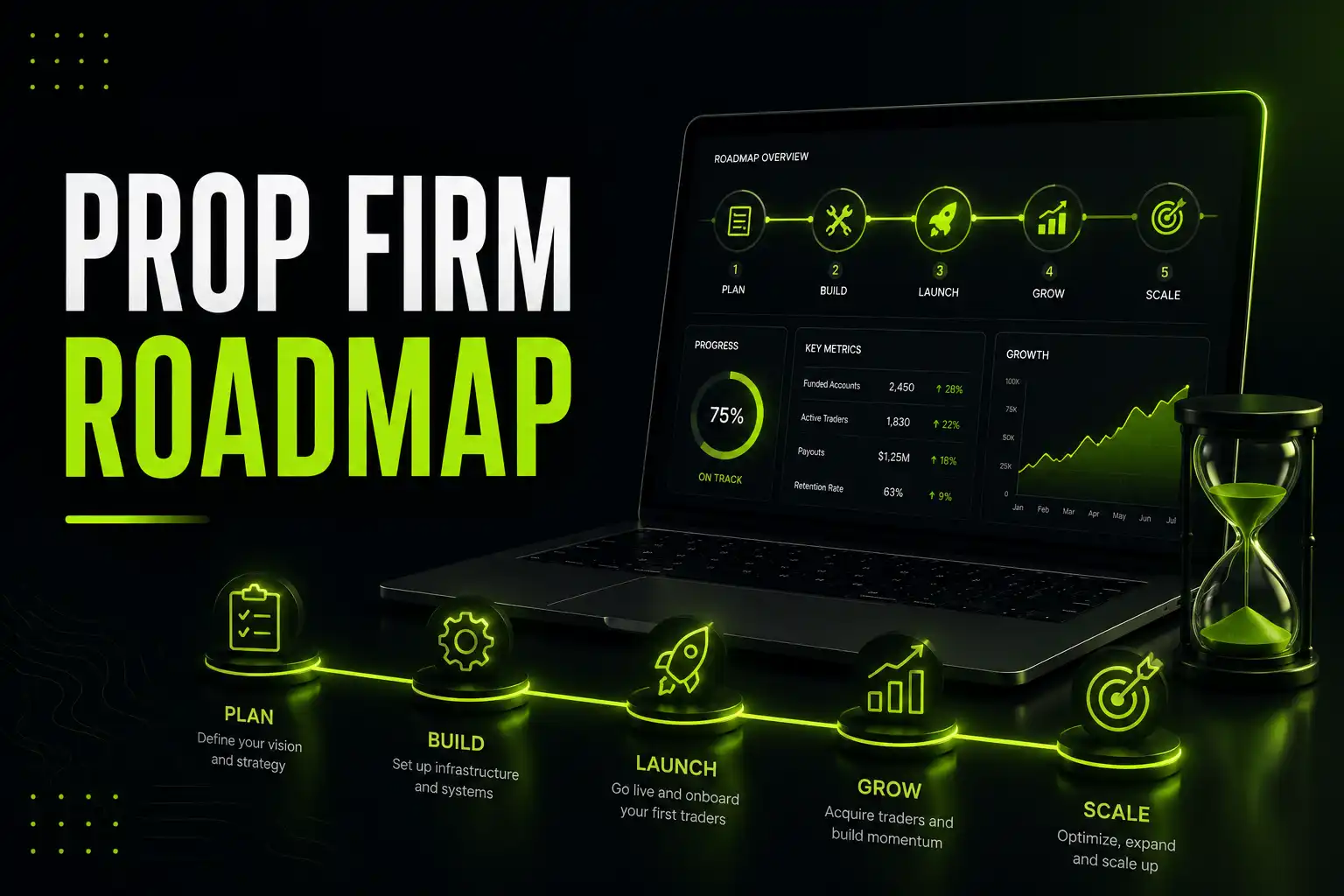
While every firm follows a slightly different path, most successful launches move through the following six stages before going live:
1) Defining the Business Model
This stage determines how the company will generate revenue, how traders will progress through the ecosystem and what infrastructure will be required later.
They must also establish challenge rules, drawdown limits, profit split structures and payout policies.
For example, a firm offering a two-phase evaluation challenge with an 80% profit split will have different operational requirements from a business offering instant funding accounts with monthly subscription fees.
This stage often takes between several days and several weeks, depending on the complexity of the model and the number of stakeholders involved.
Founders typically need to decide:
- Evaluation-based model
- Instant funding model
- Subscription-based model
- Hybrid structure
2) Selecting Technology Partners
Once the business model is established, the next stage involves selecting the infrastructure that will support traders and internal operations.
Most modern prop firms rely on a combination of trading platforms, CRMs, trader dashboards, back-office systems and reporting tools. While the technology available today has significantly reduced barriers to entry, choosing providers remains one of the most important decisions a founder will make.
The focus should not be on launch speed alone. A platform that can support 500 traders may not be suitable for a firm planning to support 50,000. Scalability, platform stability, reporting capabilities and integration flexibility should all be evaluated before agreements are signed.
3) Building the Customer Journey
This stage focuses on creating a smooth path from registration through to challenge purchase, account access and eventual payout requests. Every interaction should be designed to reduce friction and make it easy for traders to understand what happens next.
Most operational issues that emerge after launch can be traced back to poor onboarding experiences rather than technology failures. Clear communication, intuitive navigation and transparent processes often have a greater impact on customer satisfaction than additional platform features.
A typical customer journey includes several key stages:
| Customer Journey Stage | Objective |
|---|---|
| Website Visit | Educate visitors and generate challenge purchases |
| Registration | Create an account and collect user information |
| Challenge Purchase | Complete payment and gain platform access |
| Onboarding | Explain rules, objectives and account setup |
| Evaluation Phase | Monitor trader performance against requirements |
| Funded Account Stage | Progress successful traders into funded accounts |
| Payout Request | Process withdrawals and trader payments |
| Ongoing Retention | Encourage repeat purchases and long-term engagement |
4) Payment Processing and Compliance Setup
Unlike website development or platform configuration, payment processing involves third-party approval processes that are largely outside a founder's control.
Most payment providers classify prop firms as high-risk merchants due to the nature of the industry. This can result in enhanced due diligence requirements, additional documentation requests and longer approval times.
At this stage, firms typically establish:
- Merchant accounts
- Payment gateways
- KYC verification systems
- AML procedures
- Fraud prevention controls
- Legal terms and policies
5) Internal Testing and Soft Launch
Before opening the business to the public, every major workflow should be tested under real-world conditions.
Testing should include challenge purchases, failed transactions, payout requests, customer support tickets, affiliate tracking and account progression rules.
The objective is simple. Identify operational weaknesses before customers discover them.
Most firms discover issues with payment flows, email delivery, reporting systems or onboarding instructions during testing. Resolving these problems before launch is significantly easier than fixing them after hundreds of traders have joined the platform.
6) Marketing Before Launch
This approach is particularly important in today's market. The prop firm industry has become increasingly competitive, and customer acquisition often takes longer than founders expect. Building trust, authority, and brand recognition cannot be achieved overnight.
Most firms now invest in SEO, GEO optimisation, content marketing, affiliate recruitment, email marketing and digital PR before launch. While these channels require patience, they often produce more sustainable results than relying solely on paid advertising.
The firms that launch successfully are rarely the ones scrambling to find customers after launch day. They are usually the ones that have spent weeks or months building demand before opening their doors.
How Long Does It Take to Start a Prop Firm?
The timeline for launching a prop firm depends largely on the business model, technology stack and level of customisation involved.
Founders using existing infrastructure can often launch within weeks, while firms building proprietary technology may spend months developing and testing their systems before going live.
The table below outlines the most common launch models and the time typically required to bring them to market:
| Launch Model | Typical Timeline | What It Usually Involves |
|---|---|---|
| Lean White-Label Launch | 2-6 Weeks | Uses existing trading platforms, CRM systems and back-office infrastructure with minimal customisation. Typically operated by a small team with a focus on speed to market. |
| Customised White-Label Firm | 1-3 Months | Uses third-party infrastructure but includes custom branding, tailored customer journeys, additional integrations and more refined operational processes. |
| Proprietary Technology Build | 6-18 Months | Involves building custom platforms, dashboards, risk management systems and internal tooling. Requires significant development resources and testing. |
| Institutional-Grade Operation | 12+ Months | Designed for large-scale operations with dedicated teams, complex compliance requirements, multiple vendors and highly customised infrastructure. |
Top 7 Reasons Prop Firm Launches Get Delayed
Even with modern white-label technology and specialist infrastructure providers, prop firm launches frequently take longer than planned.
Below are the seven most common reasons prop firm launches get delayed:
1) Payment Processing Delays
Many payment providers classify prop firms as high-risk merchants due to factors such as chargeback exposure, international customers and the nature of the business model. As a result, onboarding often involves enhanced due diligence, financial reviews and additional compliance checks.
While some providers can complete onboarding within two to four weeks, others may require several months before approving an account. Delays are particularly common when businesses operate across multiple jurisdictions or use complex corporate structures.
2) Over-Customising Technology Infrastructure
Most founders begin with a straightforward white-label setup but later decide they want additional features, custom dashboards or proprietary tools. What starts as a six-week project can quickly become a three-month project once custom development is introduced.
Every additional feature requires development, testing and quality assurance. Even relatively small requests can create unexpected delays when multiple systems need to communicate with one another.
3) Compliance and Legal Requirements Bottlenecks
Before going live, firms typically need legal documentation covering customer terms, privacy policies, refund policies and risk disclosures. Depending on the target markets, additional obligations may also apply.
KYC and AML procedures are now standard requirements across much of the industry. Service providers, payment processors and technology partners increasingly expect firms to demonstrate that appropriate controls are in place before onboarding is completed.
4) Technology Integration Issues
A trading platform must communicate with the CRM. The CRM must communicate with the trader dashboard. Payment providers, affiliate systems and support tools must also exchange information accurately.
On paper, these integrations often appear straightforward. In practice, implementation issues can emerge during testing. User data may not sync correctly. Automated emails may fail to trigger. Affiliate tracking may not record transactions properly.
Most of these issues can be resolved, but identifying and fixing them inevitably adds time to the launch process.
5) Business Model Changes
Most founders enter the market with one concept and later decide to modify pricing, challenge structures, payout rules or account types. While these changes may improve the business model, they often affect multiple parts of the operation.
A revised challenge structure may require changes to platform rules, dashboard logic, customer communications and support documentation. A new payout model may require additional operational workflows and financial controls.
6) Fundraising Delays
Investor discussions, financial modelling, legal reviews and partnership negotiations can extend timelines significantly. Even after agreements are reached, additional time may be required before funds become available.
This is particularly relevant for firms planning custom technology builds, as development costs can quickly move beyond the budget of a lean startup.
Founders pursuing external investment should account for fundraising timelines as part of the overall launch schedule rather than treating them as separate activities.
7) Chasing Perfection
A surprising number of prop firms delay launch because they continue refining non-essential elements of the business. The logo changes. The homepage is redesigned. New features are added. Marketing copy is rewritten repeatedly.
There is an important distinction between being ready to launch and being perfect. Most successful firms enter the market with a solid operational foundation and continue improving over time.
The firms that struggle are often those attempting to solve every possible problem before acquiring their first customer.
Is It Better to Launch Quickly or Take More Time?
Most founders focus on launching as quickly as possible. While speed can be an advantage, launching before the business is operationally ready often creates bigger problems later.
A prop firm with untested payment systems, unclear onboarding processes or weak customer support can quickly damage its reputation. Fixing these issues after launch is usually more difficult and more expensive than addressing them beforehand.
The goal should not be launching first. It should be launching with confidence that the technology, operations and customer experience are ready to support growth. Spending a few extra weeks preparing often delivers better long-term results than rushing to market.
Related reads
Get prop firm growth insights weekly.
Operator-grade tactics on tech, ops and growth, no fluff, no trade signals.