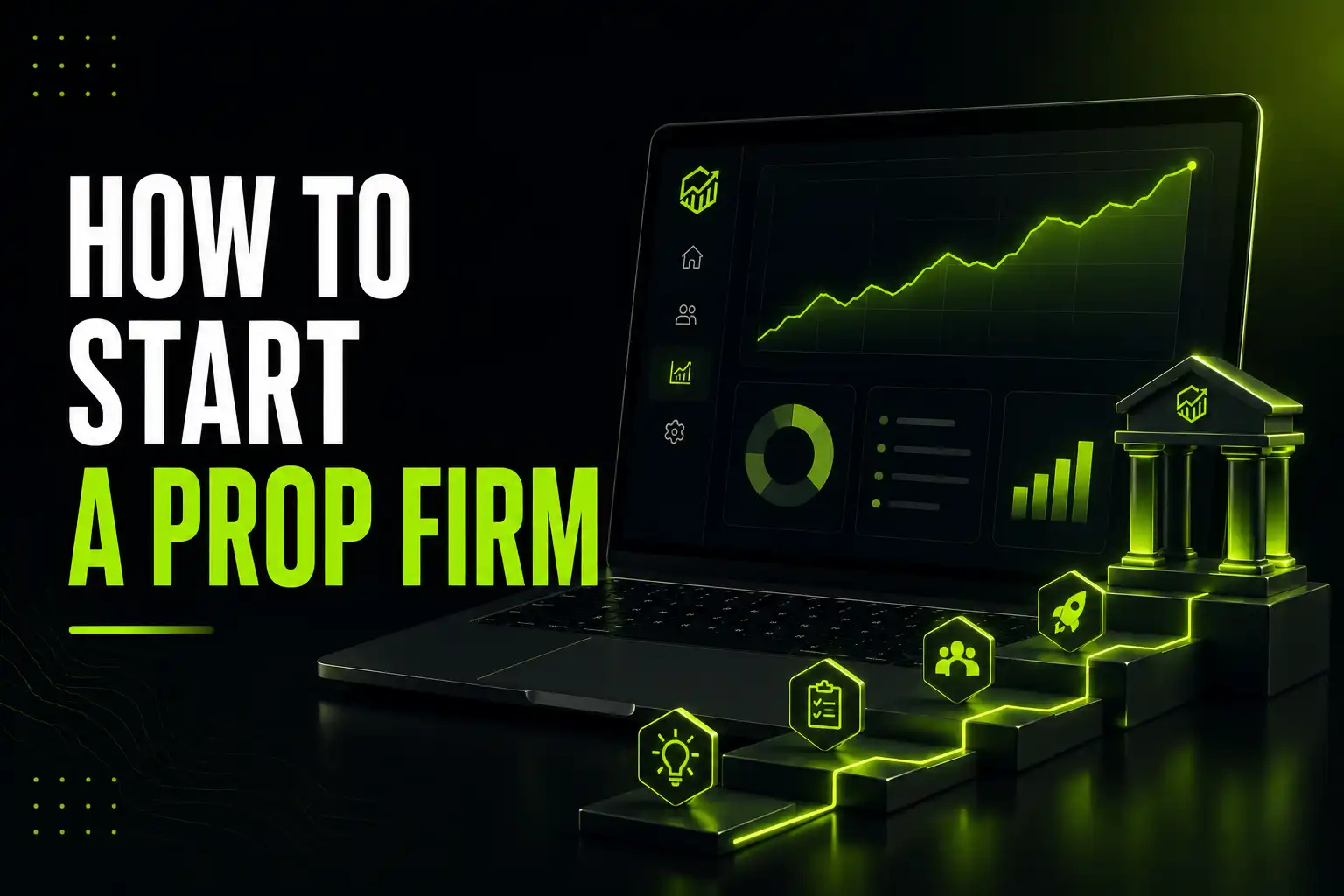
How to Start a Prop Firm
Our editors have collectively launched, advised, or operated prop trading firms across forex, futures and crypto. Every article is reviewed by an operator currently running production infrastructure.
Last updated June 6, 2026
Launching a prop firm is easier today. Founders no longer need to build trading platforms, trader dashboards, CRM systems, or back-office infrastructure from scratch. Many of these tools are now available through specialist providers, making it possible to bring a prop firm to market much faster.
That has created opportunities for entrepreneurs, trading educators, brokers, and financial businesses looking to enter the industry. At the same time, competition has increased, and launching a prop firm is only one part of the process.
Building a business that can attract traders, manage risk, process payouts, and scale efficiently requires careful planning from the start.
Keep reading to learn how to start a prop firm in 2026, including business models, technology requirements, payment processing, compliance, customer acquisition, and operational considerations.
8 Steps to Start a Prop Firm
Every successful prop firm relies on a combination of technology, operations, compliance, risk management, and customer acquisition. Missing any one of these areas can create challenges.
Here are the 8 steps to follow before launching your prop firm:
1) Choose a Business Model
Before selecting technology, payment providers, or marketing channels, founders need to decide how the prop firm will operate.
A business model defines how the firm generates revenue, how traders qualify for funding, how payouts are structured, and how risk is managed. It serves as the foundation for almost every decision made later in the launch process.
The business model also influences pass rates, customer experience, trader acquisition, and profitability. For example, a firm offering instant funding will face different operational and risk management requirements than a firm using a traditional two-step evaluation process.
Most prop firms operate using one of the following models:
| Business Model | Definition |
|---|---|
| One-Step Evaluation | Traders complete a single evaluation phase before becoming eligible for a funded account. This model is often marketed as a faster path to funding. |
| Two-Step Evaluation | Traders must pass two separate evaluation phases before receiving a funded account. This remains one of the most common models in the industry. |
| Instant Funding | Traders receive access to a funded account immediately after purchase without completing a traditional evaluation. |
| Hybrid Model | Combines elements of multiple funding models, such as evaluation challenges, instant funding programmes, subscriptions, or account scaling plans. |
2) Build Your Trading Rules
Trading rules define how traders are evaluated, how risk is managed, and how funded accounts operate.
They affect trader behaviour, pass rates, payout frequency, risk exposure, support requests, and profitability. Even small changes to a rule can have a significant impact on business performance.
Before launching a prop firm, founders should decide which trading styles, strategies, and risk parameters will be permitted across both evaluation and funded accounts.
Most prop firms establish rules in the following areas:
| Rule Category | Purpose | Common Examples |
|---|---|---|
| Profit Targets | Defines the performance required to pass an evaluation | 5%, 8%, 10%, or 12% profit targets |
| Maximum Drawdown | Limits total losses before account failure | 6% to 12% overall drawdown |
| Daily Drawdown | Restricts losses within a single trading day | 3% to 5% daily loss limit |
| Minimum Trading Days | Prevents traders from passing through a single trade | 3 to 10 trading days |
| Profit Split | Determines how profits are shared between the firm and trader | 70/30, 80/20, 90/10, or 95/5 |
| Payout Schedule | Defines when traders can request withdrawals | Weekly, bi-weekly, or monthly |
| Position Sizing Rules | Controls trade exposure and account risk | Maximum lot sizes or exposure limits |
| Consistency Rules | Prevents profits from coming from a single trade | Percentage-based consistency requirements |
| News Trading Rules | Regulates trading around major economic events | CPI, NFP, FOMC, and interest rate announcements |
| Weekend Holding Rules | Determines whether positions can remain open over weekends | Allowed, restricted, or prohibited |
| Scaling Plans | Rewards traders with larger account allocations over time | Account growth based on performance milestones |
| Account Merging Rules | Allows traders to combine multiple funded accounts | Subject to firm-specific limits |
3) Select Your Technology Stack
A prop firm's technology stack is the collection of software, platforms, and systems used to operate the business. It manages everything from trader onboarding and challenge purchases to account monitoring, payouts, customer support, and affiliate management.
In the early days of the industry, many firms had to build their own systems. Today, founders can choose from a growing number of specialist providers that offer ready-made solutions for prop firms.
Most new firms choose white-label solutions because they reduce development costs and shorten launch timelines. While this can be an effective way to enter the market, founders should ensure their technology providers can support future growth as the business expands.
A typical technology stack includes a trading platform where traders execute orders, a trader dashboard where customers can track progress and manage accounts, a CRM for customer support and communications, and risk management tools that monitor trading activity and enforce account rules.
Most firms also use KYC software to verify customer identities, payment gateways to process transactions, affiliate software to manage partner commissions, and analytics platforms to track business performance.
4) Set Up Payment Processing
Payment processing allows a prop firm to accept challenge purchases, subscriptions, account resets, and other customer payments.
Without reliable payment processing, a prop firm cannot generate revenue efficiently. It can also impact customer experience if transactions fail or withdrawals are delayed.
Before launch, founders should evaluate:
- Merchant account providers
- High-risk payment processors
- Supported countries and regions
- Supported currencies
- Transaction fees
- Rolling reserves
- Chargeback management tools
- Refund procedures
- Alternative payment methods
- Trader payout methods
- Settlement times
- Backup payment providers
5) Implement Compliance and Verification
Compliance and verification procedures help prop firms verify customers, reduce fraud, protect payment infrastructure, and support day-to-day operations.
Many payment providers, technology vendors, and financial partners expect prop firms to maintain customer verification and fraud prevention procedures before approving services.
Common compliance measures include:
- Know Your Customer (KYC)
- Anti-Money Laundering (AML) procedures
- Identity verification checks
- Proof of address verification
- Sanctions screening
- Fraud detection systems
- Device monitoring
- IP address tracking
- Account ownership verification
- Payout verification reviews
- Data protection procedures
- Record keeping and audit trails
6) Create a Customer Acquisition Plan
Customer acquisition is the process of attracting traders to your prop firm.
Without a consistent flow of customers, even the best technology, trading rules, and funding programmes will struggle to generate revenue. This is why marketing should be planned before launch.
Most successful prop firms use a combination of marketing channels to increase visibility, generate traffic, build trust, and convert visitors into customers.
| Marketing Channel | Primary Purpose |
|---|---|
| SEO | Generate organic traffic from search engines such as Google and Bing |
| GEO | Improve visibility in AI-powered search platforms such as ChatGPT, Gemini, Perplexity, and AI Overviews |
| Affiliate Marketing | Acquire traders through partners, influencers, review sites, and content creators |
| Content Marketing | Build trust and authority through educational content, guides, and resources |
| Social Media Marketing | Increase brand awareness and engage with traders across social platforms |
| Community Building | Improve engagement and retention through Discord, Telegram, and other communities |
| Email Marketing | Nurture leads, increase retention, and improve customer lifetime value |
| Paid Advertising | Generate targeted traffic through Google Ads, YouTube Ads, and other advertising platforms |
| Influencer Marketing | Partner with trading educators, creators, and industry personalities to reach new audiences |
| Digital PR | Build authority, brand awareness, and industry visibility through media coverage and backlinks |
7) Test Operations Before Launch
Before accepting customers, every prop firm should test the systems and processes that support day-to-day operations.
Operational testing involves reviewing the complete customer journey from registration through to payouts. The goal is to identify issues before they affect real customers.
Most firms also conduct internal testing using demo accounts to simulate the customer experience. This helps operators verify account creation, rule tracking, performance metrics, affiliate tracking, payment processing, and payout workflows before launch.
8) Launch and Optimise
The first few weeks and months after launch often reveal issues that were not identified during testing.
Some of the most important metrics include pass rates, payout ratios, customer acquisition cost (CAC), customer lifetime value (LTV), refund rates, chargeback rates, support response times, and trader retention.
Founders should also pay close attention to customer feedback. Reviews, support tickets, community discussions, and trader surveys often highlight problems long before they appear in business reports.
As the business grows, optimisation should become a continuous process. Trading rules may need adjusting, support processes may require automation, marketing campaigns may need refinement, and new technology solutions may be introduced to improve efficiency.
Launch Timeline: White-Label vs Main-Label Setup
Most new prop firms launch using a white-label solution because it provides access to pre-built technology, trader dashboards, back-office systems, and operational infrastructure.
The table below outlines the key differences between both approaches:
| Category | White-Label Setup | Main-Label Setup |
|---|---|---|
| Typical Launch Timeline | 2 to 8 weeks | 6 to 18 months |
| Upfront Cost | Lower | Higher |
| Development Requirements | Minimal | Significant |
| Technology Ownership | Third-party provider | Fully owned or controlled |
| Customisation | Limited to provider capabilities | Highly customisable |
| Maintenance Responsibility | Managed largely by the provider | Managed internally |
| Technical Expertise Required | Low to moderate | High |
| Scalability | Depends on provider infrastructure | Fully controlled by the firm |
| Operational Control | Moderate | High |
| Ongoing Costs | Monthly service fees | Development and maintenance costs |
| Best Suited For | New founders and early-stage firms | Established businesses with larger budgets |
Building a Prop Firm That Can Scale
Starting a prop firm is easier than ever, but building a business that can grow sustainably requires much more than technology and a website.
The most successful firms focus on every part of the operation, from business models and trading rules to payment processing, compliance, customer acquisition, and risk management.
Founders should also remember that launching a prop firm is only the beginning. The real challenge is attracting traders, maintaining trust, processing payouts efficiently, and improving operations as the business grows.
A scalable prop firm is built on strong systems, reliable infrastructure, and consistent execution. The firms that succeed over the long term are often the ones that treat launch day as the starting point, not the finish line.
Related reads
Get prop firm growth insights weekly.
Operator-grade tactics on tech, ops and growth, no fluff, no trade signals.